
A handful of clients have asked me some version of the same question lately, usually right in the middle of a reporting call: what does SEO even look like anymore with AI eating into search? I get the anxiety behind it. If you’re a local business owner, or you work in any locally based organization here in the Triangle, I wanted to share what I’ve found – partly for reassurance, partly because there are a few tactical things worth doing this week.

Quick context if we haven’t met: I’m Sally, I lead client services here at Triangle Media Partners, and fielding exactly this kind of question is a genuine part of my job – I sit in on many of our reporting calls, I hear the worry firsthand, and I’m the one who helps translate the industry noise into something you can actually use.
Most of the AI-and-search noise flying around right now isn’t written for you. It’s written for enterprise teams with budgets the size of a small city, selling products where the whole customer journey happens on a screen. A new study drops every week, somebody’s LinkedIn post declares SEO dead, another newsletter promises the one AI trick that’ll save your business, and none of it accounts for how your customers actually find and choose a landscaping company, a doctor, a school, what to do this weekend or where to shop.
If you’re one of our advertisers, or you’ve been circling the idea of becoming one, I’m talking directly to you. You’re the exact kind of business this data is describing – local, relationship-driven, the kind people have to actually choose and show up for. So let’s get into what the study found, and what it means for you, specifically.
The short story: A large industry study just tracked more than a million search terms to test whether AI chatbots are killing traditional search. The answer is not really, but it is redistributing. Purely informational searches (think insurance deductibles or appliance troubleshooting) are getting absorbed by AI chatbots. Local, transactional searches, the kind where someone actually needs to choose and visit a real business, are holding steady or growing. The catch is that AI recommends names it already recognizes, so recognition, not just findability, is what wins now.
The Study Behind the Noise
Fractl and Search Engine Land analyzed more than a million high-volume keywords across eight industries this year, testing a 2024 prediction that AI would cut traditional search volume by 25% by 2026. What they found was more nuanced than the headline suggests: overall search volume barely moved. What changed is which searches carry the weight.
Purely informational questions, the ones with a single correct answer, are exactly what AI chatbots now handle start to finish. But questions that require a choice, a comparison or an actual visit to a real place hold steady or grow. Local, lifestyle-driven categories, including restaurants, home services and boutiques, hold up best.
That’s good news, buried inside a study built to alarm marketing departments. Most of what a business like yours sells isn’t a fact an AI can answer in a sentence. It’s a table, a haircut, a repaired water heater. Nobody’s replacing that with a chatbot response.
But Here’s Where It Gets Tricky
AI chatbots are especially good at absorbing generic, non-branded questions, the ones with no business name attached. “Best plumber near me” is exactly the kind of query an AI assistant tries to answer directly, recommending names it already recognizes from around the web.
Across the study, 90% of all tracked search volume was non-branded, meaning it had no business name typed into it at all. That’s the pool AI is fishing from. Branded searches, the ones where someone already types your name, stayed the most protected category in the whole dataset, and that gap is the entire ballgame.
So this means if a chatbot’s never encountered your business name, it can’t recommend you – not because your work isn’t good, but because it hasn’t heard of you yet.
This is the piece that gets lost in headlines written for Fortune 500 teams that can buy visibility across a dozen channels overnight. A family-owned business doesn’t have that luxury, but you honestly don’t need it. What you need is to already be a familiar name before anyone, human or AI, goes looking.
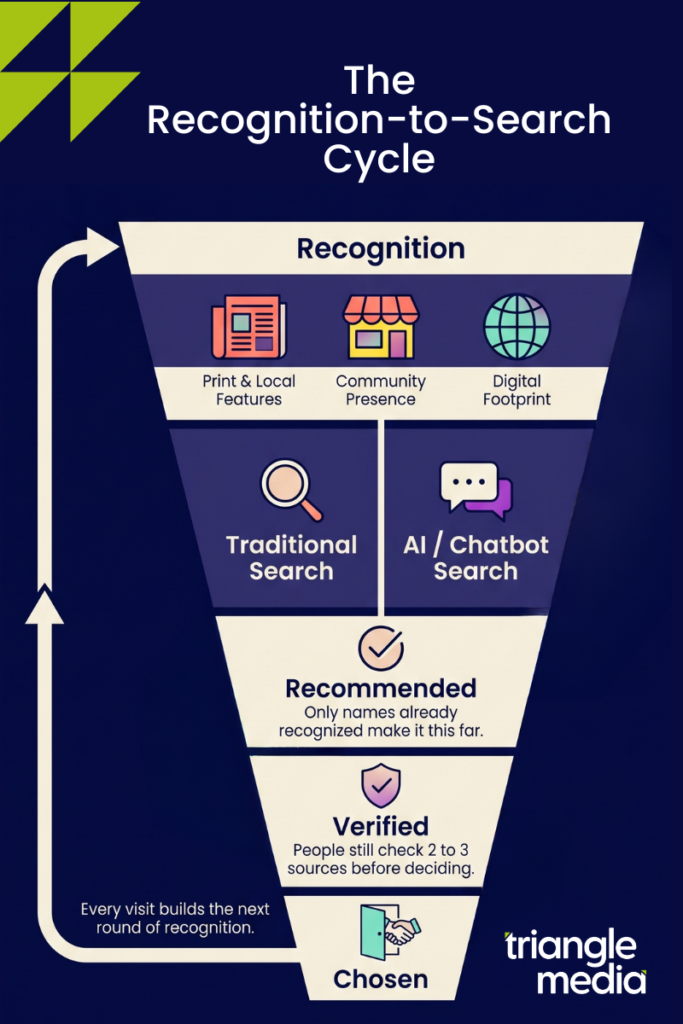
Below is my rendition of a reimagined customer journey funnel based on what the research is telling. It’s super simplified because the reality of today’s customer journey looks more like a plate of spaghetti.
Recognition Still Wins
The same study found consumers remain skeptical of AI recommendations. More than half say they verify before buying, and shoppers check three sources on average before they do. People aren’t handing chatbots their trust wholesale. They’re using AI to narrow the list, then falling back on names they already recognize to decide.
Here’s the part that should matter most to you: 59% of consumers said they’d visit a business’s website after an AI chatbot recommended it. A recommendation only turns into a visit if the business already had enough recognition to get named in the first place.
That’s where local visibility does work AI can’t beat. A name that shows up consistently in the community, in a magazine feature, at a sponsored event, in the same ad month after month, becomes the name AI doesn’t have to introduce. It’s already sitting in someone’s memory, ready to be verified.
Frequency builds that kind of recognition. One ad or one feature rarely does it. Showing up again and again, in the places your community already trusts, is what turns “I’ve heard of them” into “let’s call them.” Yes, things are changing, but human memory isn’t changing, and the importance of frequency is Advertising 101. It’s marketing physics. It’s recall. It’s baked in and it’s not going anywhere.
What I’d Actually Do This Week
Here’s where to start, roughly in order of effort:
- Claim and complete every online listing you have – Google Business Profile, Yelp, Apple Maps, and the niche directories specific to your industry. Add real photos, accurate hours, and specific service categories, and actually respond to reviews. AI tools pull from these sources constantly when they recommend local businesses, and a half-finished profile reads as untrustworthy to a machine the same way it does to a person.
- Buy print and digital together, from the start. Don’t treat one as the add-on to the other. They do two different jobs. Print builds the recognition and trust that gets your name remembered later, whether someone ends up typing it into Google or asking a chatbot who to call. Digital is what’s actually there when that moment happens: the URL, the listing, the web feature an AI system can find and point to. Print earns you the mention. Digital is what turns that mention into a click. Buy one without the other and you’re only covering half the path a customer actually takes.
- Audit your own content for what AI already answers. Go through your website and marketing and separate the pages that answer a generic question (pricing basics, simple how-tos) from the pages that require an actual comparison or decision. The first group is losing ground to AI. Redirect your energy, and your content budget, toward the second.
- Show up consistently, not sporadically. Recognition compounds. One feature or one ad rarely moves the needle. The fifth one in six months does. If you’re choosing between a bigger one-time push and a smaller recurring presence, pick recurring.
- Build content AI can actually cite. Specific testimonials, real project outcomes, “best of” mentions, and named case studies give both AI systems and skeptical humans something concrete to point to. Vague claims about being “the best” or “trusted” don’t.
AI is rewriting the rules for national brands selling information. But for businesses like ours that serve a local community, the rules haven’t changed nearly as much. Being known still beats being findable.
This is roughly the audit we walk clients through when we look at their local visibility, minus the keyword and ranking data we’d pull to make it specific to their business. If you’re already advertising with us, or thinking about it, this is exactly the kind of look we’d take at your business. If you’re staring at your own marketing wondering where you’d land on this list, I’d love to talk to you! You can find me at sally.scruggs@trianglemediapartners.com.