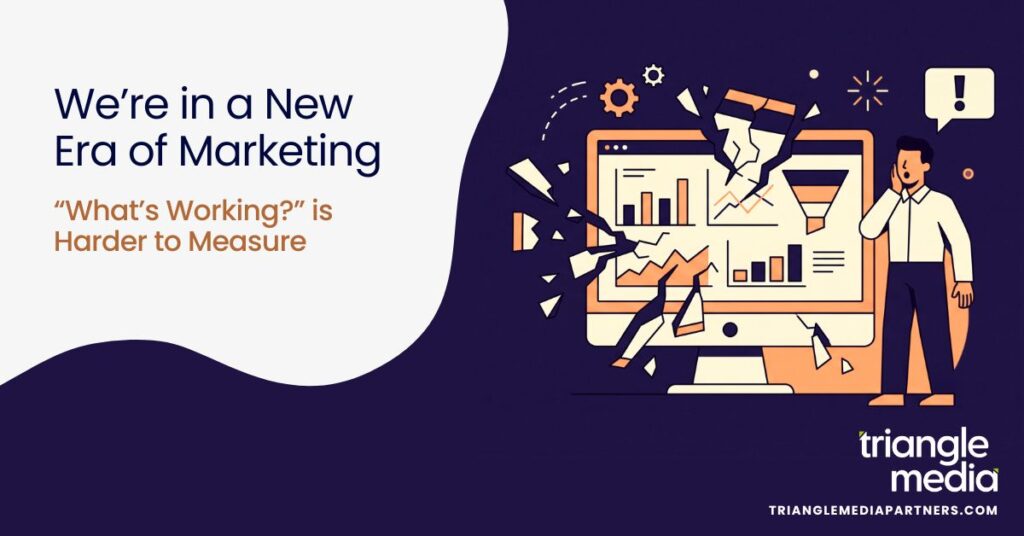
“What’s Working?” is Harder to Measure
Attribution – the whole idea of tracing a sale back to one specific ad or click – is dying industry-wide. Not just harder to do, but becoming way less relevant than it was even a few years ago. In plain speak, it’s harder to know which of your marketing efforts is working because you can’t rely on click tracking.
There are a lot of headlines out there that go something like, “AI Killed SEO,” and I find those really alarmist and reductive, so I’m not trying to do that here. Instead, I’m describing a slow and steady shift in marketing that has been happening over the last five to six years. It’s not “new,” but now certain. And importantly, it’s not even AI’s fault. AI is not the villain in this particular story, just one of many influencers.
Our leadership team at Triangle Media Partners is committed to continuous education outside of our regional bubble so that we continue to stay sharp and bring what we learn back to our client partners. All of us were bringing back this same information from our conferences and seminars and mentors.
“A new marketing era” is a pretty big deal for us as a marketing company, so we knew we needed to spread the word to our clients. We started with our Heart of NC Weddings vendor community. I went looking for more research before I’d repeat it to a room full of business owners, and the questions that came out of the webinar we hosted applied just as much to every advertiser we work with, not only our wedding clients. So I’m sharing the additional research we learned and shared with them here.

Quick context if we haven’t met: I’m Sally, I lead client services here at Triangle Media Partners, and I spend a lot of my week translating exactly this kind of industry chatter into something a local business owner can actually use.
The short story: This idea that we’re in a new marketing era is not a fringe opinion. Marketing science institutes, independent researchers, trade bodies, and advertising historians who don’t always agree with each other are converging on the same basic premise. Search is ending without a click more often, attribution as we’ve known it for twenty years is truly breaking down, and the fix is a return to the old fundamentals: being known and trusted even before the AI or Google search happens.
A Return to Mad Men Measurement
Rand Fishkin, founder of SparkToro and one of the more credible independent voices in search research (he’s not selling SEO services, so he has less incentive to spin the story), put this bluntly in a widely circulated analysis: attribution and clicks are both dying, and digital marketing in the mid-2020s looks a lot more like marketing in 1964 than marketing in 2014. His reasoning is systems-level, not based on mere observation. Apple’s cookie changes, ad blocker adoption by a third to half of internet users, multi-device journeys, walled-garden apps (Google, Meta, TikTok, etc.), and dark social traffic have combined to make perfect attribution structurally impossible.
WARC, the research and effectiveness arm now under Cannes Lions, backs this up from the trade-body side. Its 15th annual Marketer’s Toolkit, drawing on more than 1,000 marketing executives, found that AI-driven answer engines are squeezing the click-through model that’s underpinned digital marketing for two decades. Only 11% of marketers surveyed said they weren’t worried about AI’s impact on search measurement.
On the measurement side, Nielsen and Kantar are both pointing marketers back toward marketing mix modeling, the pre-digital, statistical approach to measuring advertising effectiveness that doesn’t depend on tracking individual clicks. That part should make us all pause: the fix the measurement industry is reaching for is a mid-century tool, not a newer one.
I want to be clear that all of this is about how we measure what’s working, not that any particular channel is not working. It’s just about how we match marketing spend to results. That’s the part that’s shifted.
So What Happens When Search Doesn’t End in a Click?
Google’s AI Overviews have expanded from roughly 12% of queries in 2024 to well over half by 2026, and a majority of Google searches now end without a click to any website at all. WARC’s data found nearly a quarter of marketers are already expanding budget from traditional SEO toward generative engine optimization, the practice of trying to get cited inside an AI-generated answer rather than ranked on a results page.
The practical shift is a move away from proving value through traffic and toward proving influence through presence. If a search ends in an AI-written answer instead of a list of links, “did they click through to us?” stops being answerable. The better question becomes whether your brand shows up, by name, inside that answer, and whether people were exposed to you somewhere upstream of the search entirely: a blog article, a friend’s recommendation, or even print and out of home media! Notoriously difficult to track.
All of this is a return to something older. Before you can be cited or recommended, you have to be known and trusted in the places your audience already spends time.
What Younger Customers Are Responding To
It’s tempting to lump younger consumers into one tidy story, but the research points to two things happening at once.
Edelman’s 2026 Trust Barometer, an 8th-annual study surveying nearly 17,700 people across 15 countries, found that consumers, younger ones especially, are retreating into more insular circles of trust. Sixty-six percent say they’re hesitant or unwilling to trust someone whose values, facts, or background differ from their own. At the same time, 88% say trusting a brand is as important a purchase driver as quality or price, and earned recommendations from real people now carry more weight than paid media in building that trust.
Alongside that, YPulse, a research firm focused specifically on Gen Z and Millennial behavior, found that 55% of teens and 75% of young adults say they want to “go more analog” this year: taking up offline hobbies, reading physical books, walking without headphones. Heavy digital use and a genuine craving for tactile, offline experience are coexisting in the same generation, and nostalgic, heritage-referencing brand communication is landing as more trustworthy and authentic to them, not less.
Dust Off the Old Playbook
This is the part I found most convincing, because it isn’t coming from nostalgia marketers with something to sell. This is from marketing scientists who spent the last fifteen years building the evidence base for how brands actually grow:
Byron Sharp, director of the Ehrenberg-Bass Institute for Marketing Science, and Mark Ritson, the industry’s most prominent skeptic-in-residence, don’t agree on much. But sharing a stage at Cannes Lions 2026, both landed on the same starting point: mental availability, being the brand that comes to mind first in a buying moment, is still 70 to 80% of the marketer’s job, AI-mediated world or not.
The clearest real-world proof point: OpenAI, a company built entirely on digital distribution, launched its first global brand campaign in 2025 using film-shot, emotionally driven television ads backed by outdoor advertising. After years of dismissing television as legacy media, the company that supposedly represents the future of search reached for the same brand-building playbook that built Coca-Cola and Nike, because broad reach, consistency, and emotional storytelling still outperform anything algorithmic at building the kind of recall that gets you cited by an AI system in the first place.
The AI era, coupled with broken click-based attribution, has removed the excuse marketers had for ignoring the importance of the kind of brand authority you get from placement.
What I’d Actually Do This Week
Here’s what I’d tell any of our advertisers directly, and I promise it’s GOOD news buried inside this measurement headache:
- Stop expecting to trace every sale back to a single ad or click. That standard is gone industry-wide, not just for you, and chasing it will waste budget on channels that only look good in last-click reports.
- Invest in being known and trusted where your customers already spend time: local reviews, community sponsorships, word of mouth, a consistent presence over years rather than a 30-day campaign burst. That’s what earns you a mention when someone asks an AI tool for a recommendation.
- Don’t write off traditional, tactile, or in-person marketing as old-fashioned. The research suggests it’s becoming more valuable, not less, precisely because younger consumers are actively looking for it and AI systems reward brands that already have strong recall. Yes, that definitely means print magazines and event sponsorships.
- Measure success further upstream: brand recall, review volume and sentiment, share of voice in your category, and direct or branded search, rather than only last-click conversions.
None of this means measurement is impossible. The discipline has just shifted from tracking to modeling, and from proving to building. That’s a harder story to tell a nervous business owner than “here’s your exact ROI,” but it’s the honest one that the evidence supports.
If you’re already advertising with us, or thinking about it, this is exactly the kind of thing we’re talking to clients about every day. If you’re staring at your own marketing wondering where you’d land on this, we’d love to talk. Email Chris Elkins at chris.elkins@trianglemediapartners.com and she’ll get the conversation started.
Sources
- Attribution Is Dying. Clicks Are Dying. Marketing Is Going Back to the 20th Century. — Rand Fishkin, SparkToro
- When Attribution Is a Fool’s Errand, Zero-Click Marketing Is the Way — SparkToro
- The Marketer’s Toolkit 2026 — WARC
- 2026 Edelman Trust Barometer Special Report: Brand Growth in an Insular World — Edelman Trust Institute
- YPulse Explains: Why Gen Z Is “Going Analog” — YPulse
- From Mental Availability to Mass Marketing — Ehrenberg-Bass Institute for Marketing Science
- Mark Ritson: ChatGPT’s New Ads Show Even AI Can’t Deny the Brand-Building Power of TV — The Drum