
In my last two posts, I described a new era of marketing where the old ways of measuring success are no longer telling the whole story.
To recap, last click attribution (measuring your marketing tactics by tracking the last touch point that converted your lead) is shaky at best. A single ad exposure isn’t going to cut it, and most of what leads someone to make a purchase or reach out isn’t happening in a linear way. There is a complex web of touch points that your customer has to experience before they decide to buy from you or work with you.
So what are we to do? Most of the clients we serve are small to medium-sized businesses, and you aren’t sitting on a pile of fancy analytics tools and may not even have a dedicated marketing team. I promise you do have the basics available to you.
I’m going to give you some actionable steps for how to measure what’s working and not another “the landscape is shifting” monologue.

Quick context if we haven’t met: I’m Sally, I lead client services here at Triangle Media Partners and I spend a lot of my week translating exactly this kind of industry chatter into something a local business owner can actually use.
The short story: You don’t need expensive tools to know what’s working. What you do need is one consistent question, a few free metrics you already have access to and a shift in mindset: stop obsessing over weekly wins and start tracking how things trend over months. Below, I break it into two tracks – one for sales-driven businesses, one for impact-focused organizations – and wrap up with a four-week starter plan to get you going.
For Everyone
The primary goal for this kind of tracking is to find correlations between marketing effort and business outcomes.
No matter what kind of business or organization you are, the key to tracking your marketing efforts is to do it consistently.
- Pick some metrics to track consistently: Here are some ideas:
- How did they find us?
- Monthly search impressions for our brand name
- Website traffic
- Email subscribers
- Number of current clients
- Determine what you’ll use to track: Based on the metrics you want to track, there are different tools you can use to track them. There are examples below of free tools you can use to track, but make sure you have an idea of how you will track each metric identified above.
- Don’t forget to track these metrics alongside your marketing efforts. You’re going to want to see how these metrics compare month-over month-to the marketing channels you employed. Did you run an ad or a billboard in January and then see a spike in traffic in March? These are the kinds of correlations you will be able to see when you track well.
- Keep your tracking simple. This could be a shared spreadsheet in Google Drive. Make sure that the right people have access to it if you are on a team. Make sure it’s easy to read, and don’t make it too complicated to start. If you’re just starting out, maybe there are two or three metrics that you are tracking, or maybe you are simply downloading data from your CRM and adding a few extra columns to track how they found you.
For Businesses Focused on Sales
No need to invest in a new platform. What you really need is a habit and a couple of tools you likely already have access to:
- “How did you hear about us?”: This one may sound like a no-brainer, but it’s important to have some context for why it’s important and how to use this data. Ask this question at checkout, intake or booking. Write it down somewhere consistent. Sure, it’s not scientific, but it’s still going to give you some valuable information about what the customer believes is the tipping point that brought you to them. It’s important to note that this doesn’t mean that that’s the only or best channel that led them to you. It’s one of the touch points that they received, and it was the one that made the most impact on them based on all of the other touch points they already got from you.
- Google Search Console. Connect this free tool to your website so you can get real search trend data about how people are searching for you, what searches you appear for, and what’s getting them to click on your site. You can chart month-over-month and year-over-year progress and compare that to the campaigns you were running leading up to those peaks and valleys.
- Focus on trends, not one-off wins. The big question is not, “Did this ad work?” Instead, ask, “Are our branded search numbers, reviews, and repeat visits trending up this quarter?”
For Organizations Focused on Impact
Nonprofits, schools, municipal governments and community groups face the same measurement challenges, just aimed at a different goal: donations, volunteer hours, service requests or awareness instead of sales. The solution? It’s almost the same as above, just tailored to your outcomes.
- “How did you hear about us?”: This one may sound like a no-brainer, but it’s important to have some context for why it’s important and how to use this data. Ask this question at the volunteer sign-up, donation form or intake call. If you’re a larger entity, maybe you’re doing impact surveys before or after an initiative to see if positions or sentiment change.
- Google Search Console. Connect this free tool to your website so you can get real search trend data about how people are searching for you, what searches you appear for, and what’s getting them to click on your site. You can chart month-over-month and year-over-year progress and compare that to the campaigns you were running leading up to those peaks and valleys.
- Focus on trends, not one-off wins. The big question is not, “Did this ad work?” Instead, ask, “Are our branded search numbers, reviews, and repeat visits trending up this quarter?”
- Log referrals from other organizations. You’re probably already doing this informally – “That family came to us from the food bank” or “That donor heard about us at a community event.” Write it down. It turns word-of-mouth into an actual metric.
- Trust signals. Repeat donors, returning volunteers or families coming back to your programs are all proof of trust.
- Track earned mentions. For you, this might mean being cited in a local newsletter, a community Facebook group or another nonprofit’s bulletin. You can set this up with a free Google Alert on your organization’s name.
- Turn stories into data. A specific success story – a donor who connected with your mission or a family you helped – is as compelling to grant funders or boards as any spreadsheet. Treat those stories as part of your measurement system, not an afterthought.
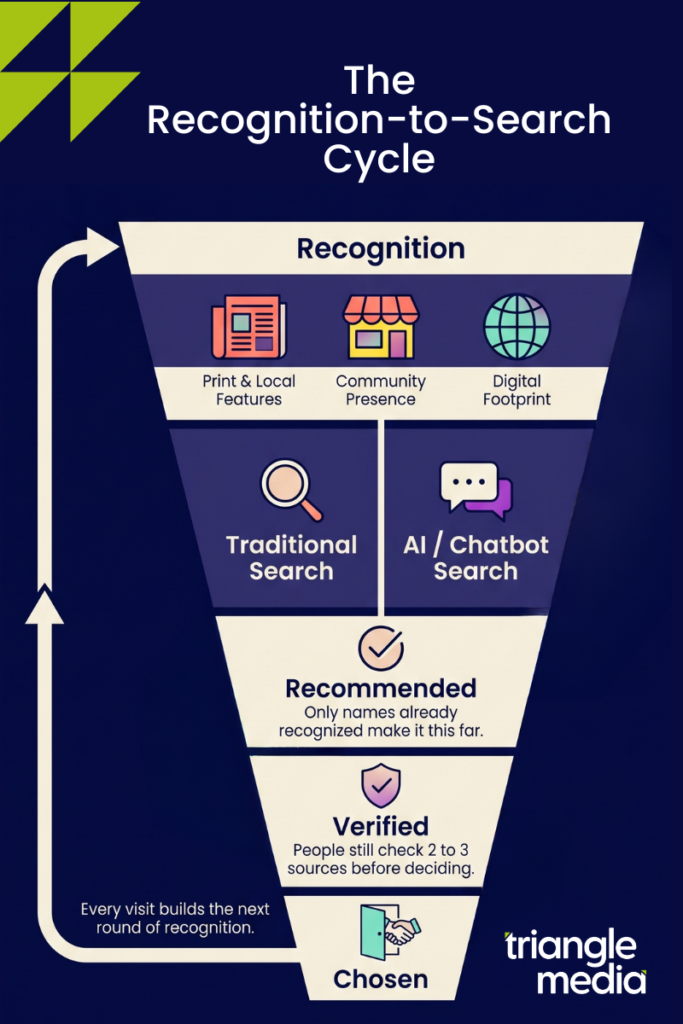
Ideally, Metrics Track Each Part of the Sales Funnel
Once you review your tracking document, identify any areas of the funnel that you are missing. I’ve included the recognition-to-search cycle that we use in conversations with our advertisers to talk about all of the different touch points a customer needs before they make the decision to move forward with you.
Having trackable metrics for each part is ideal not only to see what’s working, but also to ensure coverage across all parts of the cycle.
An Example Marketing Metrics Tracker
I mean it when I say “simple” spreadsheet! Here’s one that I made for you in Google Sheets that you can make a copy of and tweak to suit.

Your Four-Week Measurement Starter Plan
Now that you understand the theory of tracking metrics in this new marketing era and have a tracker you can start with, here are some actionable steps that you can work into your weekly to-do list to actually implement these recommendations.
This plan works for both sales and impact goals. Each week’s steps are designed to fit into the cracks of your already-busy schedule. Again: No extra software. No new budget line!
Week 1: Set Up Your Listening Post
- [Low effort, ~15 min] Add “How did you hear about us?” to your checkout, booking form, intake sheet or donation/volunteer sign-up process.
- [Low effort, ~20 min] Fully fill out your Google Business Profile (hours, categories, photos, website link), and check the Insights tab to see where you stand today.
- [Low effort, ~5 min] Set a free Google Alert [here’s the link] for your business or organization’s name (and any common misspellings).
Week 2: Establish Your Baseline
- [Low effort, ~20 min] Set up a simple shared spreadsheet to log “how did you hear about us” responses. One column is all you need. (This is done for you if you use my link!)
- [Low-Medium effort, ~30 min] Record your current numbers: Google Business Profile views, direction requests, calls, reviews and any other metrics you track. This is your starting line.
- [Medium effort, ~1 hour] Ask 3–5 recent customers, donors, or volunteers for a review or a brief quote about their experience.
Week 3: Listen Beyond Your Channels
- [Low effort, ~20 min] Search your name online, or ask an AI tool something like, “best [your category] in [your town].” See what’s being said about you – good, bad or missing.
- [Medium effort, ~30–45 min] Check in with one referral partner – another organization, business or agency that sends people your way – and ask how those people typically hear about you. Start logging that data.
- [Medium-High effort, timing varies] For mission-driven groups: Write down one specific success story (with permission to share later).
Week 4: Build the Habit
- [Low effort, ~10 min] Set a recurring monthly reminder to check your Google Insights, review count and “how did you hear about us” log.
- [Medium effort, ~30 min] Pull together everything you’ve tracked so far into one page. This is your baseline snapshot for future comparison.
- [Low effort, ~15 min] Optional: Share your baseline with a teammate or board member so someone else is keeping an eye on the trendline too.
Here’s the bottom line: It’s much harder to track what’s working using the tactics we relied on over the past 15 years. Tracking metrics are going back to basics: impressions and reach and frequency.
This is a system for noticing, month after month, whether people are finding you, remembering you and coming back. As a local business or organization, that’s a scoreboard that has always been more useful anyway, and now, in an AI-driven world, it’s essential.
If you’re already advertising with us, or thinking about it, this is exactly the kind of thing we’re talking to clients about every day. If you’re staring at your own marketing wondering where you’d land on this, we’d love to talk. Email Chris Elkins at chris.elkins@trianglemediapartners.com and she’ll get the conversation started.